Outdoor concrete slabs endure constant abuse from changing temperatures and shifting weather. Promptly addressing those cracks, fractures, and buckling areas could save you money on more extensive services later. At Liberty Concrete Inc., we’ll transform your concrete structures back to their original state.
We often recommend concrete repairs and resurfacing in addition to aesthetic services like professional floor coating installation. Concrete surface treatment and other restorative services prolong your concrete’s longevity. You’ll maintain safer, more stable surfaces with repair services.

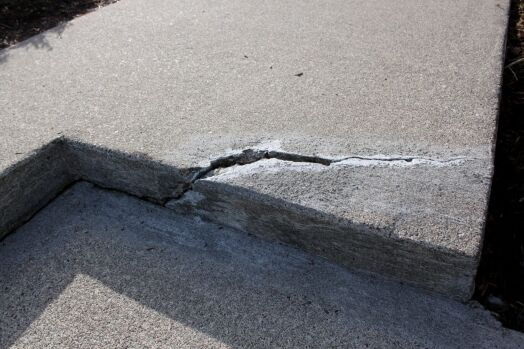
Tree roots grow in all directions, gravitating toward sources of water and nutrients. Sometimes, they find those resources beneath your concrete. The roots push further beneath the slab, putting pressure on the material from below.
This causes your concrete slab to buckle upwards. Our team can grind the buckled areas and resurface them. Your concrete slab will look as good as new!
Concrete can absorb water despite being a solid surface. The water freezes and evaporates over time, depending on the weather. The concrete slab expands and contracts, causing cracks and fractures across the surface.
Our approach to such concrete repairs involves filling the cracks and resurfacing the slab for a seamless, uniform surface.
Do pertinent plumbing networks rest beneath your driveway, carport, or sidewalk? If so, you might encounter issues that require your plumbing service to access the underlying pipes. Our saw-cutting services minimize damage as much as possible.
Then, we’ll re-pour the saw-cut area. Your Dallas, OR home will look as good as new!
Although durable, concrete can still sustain damage from exposure and usage. Some damage concrete slabs incur include:
Scheduling repairs from professionals can increase its lifespan and your property value. Plus, you can follow the repairs with our decorative concrete services for added beauty!
Yes, contractors can often repair isolated cracks and damaged sections when the surrounding concrete and base remain stable. Large moving cracks, widespread settlement, severe deterioration, or more serious structural damage may call for removing and replacing part or all of the affected slab instead.
Address cracks early so water, debris, and continued movement have less opportunity to cause additional damage. A contractor can determine whether the crack needs filling, sealing, resurfacing, or another repair based on its width, location, movement, and the condition of the slab around it.
Raised or uneven sidewalk sections can create a trip hazard, especially along frequently used walking routes. Depending on the amount of displacement and the condition of the concrete, a contractor may grind down a raised area, repair the affected section, or recommend replacement.
Concrete can crack because of shrinkage, ground movement, poor drainage, repeated loading, tree roots, temperature changes, or moisture working through vulnerable areas. Oregon’s wet seasons can make drainage and water management especially important around driveways, patios, sidewalks, and other exterior slabs.
Repair usually makes sense when damage affects a limited area, and the rest of the slab still has a stable base and solid concrete. Replacement becomes more practical when you see widespread settlement, major movement, deep deterioration, or damage that reaches through a significant portion of the slab.
FAQs reviewed by Joseph McGowan, owner of Liberty Concrete, a licensed concrete contractor.